Monday, September 24, 2012

Apple’s Dilemma – Find the Next Jobs or Rest on his Laurels?


Some thoughts following Apple's lawsuit and questionable iPhone 5 features.

Whenever the Dalai Lama passed on in Tibet, the Lamas went out in search of a reincarnated soul.

Should Apple consider the same thing?

Face it, Apple without Jobs looks a little less magical by the day. Like the Teflon peeling off an old pan, without the talent and charisma of this one man, you see what’s beneath the surface and it looks pretty base.

The iPhone without Google Maps is deficient since it is one of the most used features in smartphones with its turn-by-turn directions. Apple aficionados will work around it just as they accepted 3G when everyone else had 4G. The thing about genius is that it has certain trajectory – as long as people think breakthroughs are still coming, they forgive everything.

So it is with Jobs’ legacy. For now.

When Apple sued its competitor, Samsung, for infringement, the Apple devotees cheered. Closer examination showed these were not utility, but the weaker, design patents, and a hometown jury handed Apple a big victory over such laughable innovations as a “rounded rectangle.” 

With Jobs at the helm, his followers would have seen this as the ultimate validation. Jobs had made clear his willingness to undertake “thermonuclear war.” But we can expect years of appeals and with a phalanx of lawyers and generally anonymous executives in command, Apple is starting to look like any other corporation rattling its proprietary saber.  All this in crowdfriendly, open source world.

To make matters worse, Apple lost Jobs’ creative alter ego, Jonathan Ives, partly one supposes because Jobs treated him as his vessel in the creation of the iPod and the iPhone, and not as his partner. As for being a successor, that never came up. The British, of course, see him differently: he is now Sir Jonathan Ives. But now he designs for the Android world.

The man running Apple, Tim Cook, truly was Jobs’ vessel. He perfected Apple’s supply chain and lives a near-monastic lifestyle keeping this marvelous temple of American ingenuity alive.

Now that we are beginning to see the implications of the post-Jobs world – it is worth asking what really is to become of Apple? Is that a temple to grow innovation or one that will mostly remember it?

Let’s face it, Jobs was like no other exec in America. I have met him personally and you can be sure he was different from a CEO – any CEO – as a dictator is from an elected president. Running for office – of any kind – was not part of his agenda. In fact, by inventing the future, Jobs was free to act like a mid-eastern potentate from the Sheherezade or a kind of Howard Hughes of tech. His style was abrasive, his utterances unedited, punishment could be drastic and the next result was debilitating to most underlings. He never had to deal with labor unions and he found a way to set his own pricing standards with margins that astounded competitors. If this were anyone else, we would be talking about a price gouger. But somehow, he was a saint.

The Jobs we know, was an icon in the religious sense of the word. Thanks to Walter Isaacson’s biography, we know he considered himself special and that normal rules did not apply to him.

He fit the mold of a Biblical prophet - founding an industry that changed the world as profoundly as any religions while still in his twenties, only to be sent out to the wilderness by the man he hired, John Sculley. Then you had the amazing second act where he was invited back 10 years later to save the company as it was faltering.

This might as well have been the second coming as far as his followers were concerned and they stuck to him just as if they had joined a cult, which indeed they had. Like any cultist, they accepted sacrifice in the name of their leader and they forgave him when he overcharged early adopters on the iPhone – only to suddenly drop the price on them. They overlooked the flawed the antenna of the iPhone 4, the unchangeable batteries, the bad MobileMe and so on. They camped out for days just to buy these products and they would probably have walked on hot coals if he'd asked.

Clearly, the fanaticism lingers. But without Jobs you have to wonder if there isn't a certain deja vu - a revisiting of the era when Apple was run by a bunch of sue-happy, no-name executives who knew their stuff but had no magic?

Back in the 80’s when Jobs was first put to the sword, the former Pepsi exec he hired, John Sculley, took over at Apple. He was a quick study who realized that he needed to show his creative chops while also being a true corporate exec. He was polished and mature where Jobs was the irascable child. Sculley sued Microsoft for stealing the Mac interface. He won some victories but you have only to look at any computer to see how that played out.

Sculley also created a concept product called the Knowledge Navigator which became the Newton – arguably the futuristic prototype of the iPhone. However, he did so at the expense of Apple’s real business – usable computers, lightweight laptops and customer growth - and eventually he lost his job.

Apple without Jobs has a history of faltering – not at first – but inevitably because the kind of creative spirit it required is not a product of any Business School or Technology Institute. However, you could not work for Apple at that level unless you had qualifications from institutions like that. So let’s not wait for the next Jobs to show up at Apple’s Human Resources department anytime soon. His or her resume may be in the mail but it won't be read.

So there’s the dilemma, should Apple look for an innovator who is willing to risk being a bad exec but a charismatic technology leader, or pick a qualified CEO who will sacrifice good governance in pursuit of innovation?

Or should Apple find a reincarnation of Jobs?

Hint: he or she, is out there - but probably starting their own company.

Question: if Apple discovered them, would they try to hire them or put them out of business?


Tuesday, September 11, 2012

9/11 - The Day Silicon Alley Looked Helpless - Except for One DotCom'er


When Tech Seemed Irrelevant: iBreakfast Looks Back to 9/11


Despite everything – we had a hero. But not who or what you expected….

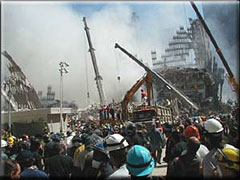
9/11 was a double whammy for Silicon Alley. The dotcom bubble had burst in April 2000 and by September 2001, whatever was left of the first wave of dotcom'ers was barely hanging on. We had even scheduled an iBreakfast about coming back from the crash with BusinessWeek editor and author, Michael Mandel.

And then this!

We remember the personal tragedies: the crowds gathered at open air spaces all over Manhattan holding up pictures of loved ones and asking if anyone had seen them. These were the saddest gatherings I have ever witnessed…..especially because we all knew the answer.

As for Silicon Alley, it seemed irrelevant.

The pictures they held up were not digital. Social Media had not arrived to make to connecting with loved ones easy. My neighbor, one of the few survivors from Canter Fitzgerald, was only recognized in the hospital because of his dentist’s business card in his jacket.

Digital was just not around. Cell phones were the primary means for people to connect. One colleague, who was in the concourse beneath the towers, was warned to get out by a phone call from a relative in London!

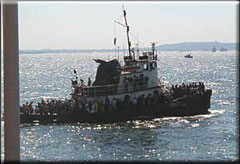
The only contribution made by a member of the Silicon Alley community that I am aware of, was by Andrew Furber, who happened to be a volunteer on a retired NYFD Fireboat. Andrew went down to Battery City with the fireboat, doused the fires with their powerful hoses and then cut away rebar to help trapped survivors. All pre-war technologies and the Fireboat was a survivor of that depression too. 

Later, when Andrew got home, he took time to update his website. 

The rest of us were just helpless bystanders or worse, victims.

The iBreakfast held a Silicon Alley Town Hall meeting called the Technology Response Council and followed up with several events that introduced us to facial recognition (Visionics), document verification and various security-related technologies.

In our Town Hall Meeting we drew some of the following conclusions:

  1. More sophisticated warning and information system using web technologies. (Probably done – thanks to smart phones and numerous other emergency systems.)
  2. An "EZ Pass" System for verified travelers. (Somewhat done.)
  3. More web driven surveillance and Artificial intelligence technology (We shudder to think…….)

It is worth asking how we would cope if a terrible disaster were to happen today?

One thing is certain, the dotcom revolution not only survived but moved to center stage.

So will America.


REPORTS FROM THE 9/11 ERA ON SILICON ALLEY

A Special thanks to Michael Drapkin for Remembering

From October 2001
--------------------------------------------------------------------------------------------
WTC: THE HERO WEB MANAGER AND THE LITTLE FIREBOAT THAT COULD

How many of us have felt remarkably useless in the aftermath of the Sep. 11 attack?

You wouldn't if you were Andrew Furber, an e-business integration project manager who has worked with the iBreakfast organization on several projects in the past. Furber had been a volunteer member of the John J. Harvey, a retired 1931 New York City fireboat that group of enthusiasts had revived. His work on board, and on her pier] as a welder and engineer led him to a fill-in job after he was laid off from his company, dmind.

On the day of the bombing he was cycling to work on Pier 63 in the Chelsea area when he saw the flames appear on the Towers. As he headed toward the fireboat he saw dazed people stumbling up the West Side Highway.

When he arrived, he learned that NYFD dispatchers had called the mighty fireboat back into service under her last designation as Marine 2. As a working fireboat with powerful water pumps, she was critical to the rescue effort because the water supply downtown had been incapacitated.

When they arrived at Ground Zero the fireboat crew set about reconfiguring the hoses to supply water to the firefighters. Furber, whose background is in telecommunications, satellites and the web was pressed into service as an oxyacetylene steel cutter. Wielding his fiery torch, he followed the rescue crews to cut apart steel beams so that trapped people could be retrieved.

Furber returned to the site every day working long hours until Friday when he was shut out of the site because of heightened security during President Bush's visit.

When asked how he dealt with the horrific scene, Furber, who has nothing more than a lapsed CPR and 1st Aid instructor certification, said "I am really lucky that I was able to help." Being able to do something made him quickly get over the horror. And weeks later he has adjusted well, knowing that he had an effective part to play in the Tragedy.

We are very proud of Andrew at the iBreakfast and we would like to honor the spirit of volunteerism and simple, matter-of fact heroism he exemplified. For those of you who wish to share your good thoughts, contact him at SAiBC@andrewfurber.com. For those fascinated with the little fireboat that could, visit www.fireboat.org.


--------------------------------------------------------------------------------------------

AFTER THE DEPRESSION - NEW BUSINESS MODELS FOR THE NET
Report on the Sep 25th iBreakfast Meeting

After a moment of silence, the September 25 iBreakfast considered the terrible events we have encountered. No one really asks to be a prophet but it was hard to ignore the sadly prophetic tone of the event: it had been specially scheduled later than the typical 3rd Wed. to avoid the High Holy Days, and the topic - recovering from the depression was, in the words used to describe the speaker, Michael Mandel's book, "eerily prescient."

Mandel, the economics editor of BusinessWeek, who also wrote this week's cover story, predicted the drastic depression, in his 2000 book, "The Coming Internet Depression" because of the underlying business model of innovation that he had discerned: technology R&D had essentially been outsourced to VC-funded start-ups. Since the whole industry had grown on the expectations of VC returns from IPOs and colossal buyouts more than the start-ups collapsed: big companies had been feeding off the start-ups and the telecom expansion which in turn had been paying for the massive underlying infrastructure. Once the market collapsed, it would do a great deal more harm than damage a few VC portfolios -it would undermine the entire technology, new media and telecom chain.

The reason he predicted that the depression would be even worse than expected is because the major corporations may have survived, having outsourced their R&D, now had very little new product in their the pipeline.

Nevertheless, Mandel felt there was enough of an infrastructure in place that the outlook was fundamentally optimistic for the long term. The shakedown, in that scenario was probably healthy.

But that was before September 11th.

The future is much more difficult now: government support will never be enough to recover losses, the human and business confidence losses will continue for months to come, there is no equivalent of turning technology factories into war production factories and it is clear that the government will take over what had once been the free market and VCs for funding and business support.

That means a slower moving, substantially less entrepreneurial environment. But the industry will have to get used to it in order to get along.

In a panel following Mr. Mandel's speech with Larry Chase from Chase Online Marketing, Michael Drapkin from XB5 and Mark Oster from Grant Thornton, it was clear that companies need to think long and hard about back up procedures and much business will surround the retooling of business for security. If there is a bright spot - it is that spending for civilian security will increase dramatically and that may present opportunity for entrepreneurs.

Michael Mandel welcomes further discussion at michael.mandel@businessweek.com


http://www.drapkin.net/news/wwwibr.html

"Startupalooza" Sells Out

Nothing seems to be growing quite as fast as the Startupalooza Community.

The combination of a open showcase and meetings with a dozen VCs seems to keep the drive for entrepreneurship alive. 

The winner was Robert Hertzog's eCaring

The Runners up were:

MyBillRegistry
MedStartr
Ruzuku

eCaring will be at the Private Equity Forum at the Yale Club on Sep 20.

Look out for the Next wave of Startupaloozas in NY, DC, CT and Boston.


Saturday, July 14, 2012

How a Start-Up shouldn't End Up. A cautionary tale

This sad story reminds me of the down-spiral of DeLaurean and Josh Harris from Jupiter. This, however, is pure pulp and probably opens the door to a number or other outrageous stories.

And yes, it could be a movie. More Hollywood that Start Up Dotcom ever was...!


http://www.nypost.com/p/news/local/manhattan/web_whiz_snared_in_drug_and_gun_6MfFREiS3B9P1hKzmfeoIN

Monday, July 2, 2012

PITCH iEvening June 25th Report

The theme was all about finding a missing element – the one that sells.

The winner was MyBillRegistry. They did it with a great presentation. On the surface, this was not the prime application for an Angel event since it occupies the intersection between education and the cash starved student. Instead of sending money which could go astray or forcing the students to beg, you can pay down their bills directly. It is like America’s new begging bowl, full-time rent party for family, a gift registry for bills.

What sold it was the momentum of their partners in banking and education publishing plus their enthusiasm.

So what was missing? The vision of other kinds of bill-sharing and that could make this really big. Schools could use this to help raise money for educational material. Or perhaps it was just a reflection of our slugging economy the requires young people to get support from their extended families.

The runner up, Hashtips is selling an intelligence system based on parents’ interests in products which then delivers to them reviews and buying opportunities using semantic analysis and other tools. The idea is great and is easily understood as a kind of Pinterstest for parents buying for kids. But that is also the problem, how do they coexist with Pinterest which could also incorporate their own version of this technology into their site? What’s missing is the Social Media coexistence strategy.

Another great contender, Bump Agent, offers to turn airline reservations bumps into a kind of marketable commodity. The problem may be that it is too dependent on airline cooperation and not enough of a marketing plus for passengers. Adding gamification could make the difference.

Ladybug Teknologies is in the business of introducing breathalyzers to bars and consumers. This is an obvious need for all kinds of reasons – not the last of them being the ratcheting up of DUI enforcement and penalties. They have consumer products –$2 single use items that seem promising and certifiably accurate kiosks. However, they are licensed technologies and angels rarely invest in licensed deals, they want you to own the tech. The bigger issue, which applies to their in-bar kiosks, is that people don’t love these things. Are they are like seat belts – no one really asks for them so you need laws and other techniques to get them adopted. Or is this more akin to a party spoiler - like having a scale at buffet. What missing element would make you want to weigh yourself? Gamification, perhaps. Weigh and win a prize!

City-Car is one of these ideas that seemed quixotic when it started out around 20 years ago. Then along came Zipcar and all of sudden, the concept of interval ownership of cars seemed possible. Or did it? The angels thought not. This is a classic “crossing the chasm” issue for a class of new ideas. When one of a class makes it, does it mean other will. Start-ups often look at the breakthrough companies that have done the seemingly impossible and say “well if they can, so can we.” But can they? In this case the flaw is comparing partial ownership to partial rentals (zipcars). If they can make a case for a different kind of psychology about car ownership – as in driver no longer take pride in ownership - and the dispersion of vehicle assets across peak hours, they might have a shot.

Mr. Phone Game is an interesting idea about bringing poplar game shows to the cell phone. Here, the game calls you. It lacks a visual interface - after all, most people will wind up with smart phones and a few test customers that show that it really works. On the other hand they just may need a couple of really good clients and investors may not be required.

Gyaneek is a search engine focus on high value products like houses or cars. It was developed by a genuine ad agency database scientist. It just needs an ad person who knows how to sell. The issue is positioning and marketing. Not to many start-ups have been able to crack the Search Engine game. This is one place where have just 1% is a very big deal. But neither Google nor Bing are giving up anything unless you can make an incredibly compelling case.


I will be appearing at the Health 2.0 Shark Tank on July 18 health20nyc.com - and back with more Entrepreneur events in August.

Wednesday, June 13, 2012

Report from Healthcare Kickstarter


iBreakfast at Fordham Lincoln Center 
G
  Report from 
HEALTHCARE KICKSTARTER: 
Mobs, Machines, Matchers & Moolah!

Medical/Health Start-Ups, Incubators & Crowdfunding  


Over 200 people swamped the President's Lounge at Fordham as the collaboration between iBreakfast and Health 2.0 discussed the tectonic shift in healthcare entrepreneurship. The City and State are planning to make NYC the hub of medical innovation.

Dave Whitlinger of the NYeC announced a multimillion dollar fund that is taking applications for $300,000 stakes in healthcare start-ups. What makes this so compelling is not just the money but also access to stakeholders and a list of their actual needs. Now you can tailor your idea to a known market.

By bringing the healthcare industry along with the payers to the table dramatically the outlook of the healthcare startups is dramatically changed.

In a room brimming with a new generation of Start-Ups the issues are now capital, understanding investor fundability, collaboration with tech people, the challenges of developing a product, selling it and then running a business.

Video and in-depth report to come.


THE PANEL:
David Whitlinger, Executive Director, NYeC Health  
Brad Weinberg, Blueprint Health
Tom Olenzak, Robin Hood Ventures
Ben Chodor, Happtique
Steven Krein, Co-founder/CEO, StartUp Health
Alex Fair, Medstartr NYeC 
Milena Adamian, Director, Life Science Angel Network 
Todd Pietri, Milestone Venture Partners
Pete Ellis, Founder, Welltech Funding,
Jean Luc Neptune, Health 2.0
Mike Monson, VNSNY  


Accelerators / Grants: David Whitlinger, Executive Director, NYeC Health Collaborative. NYeC just announced a Multi-Million Dollar Grant program called the Digital Health Accelerator which offering up to $300,000 per selected applicant. Previously, Dave was a Director at Intel where he was responsible for Intel's healthcare device interoperability strategies and the
standards development to support those strategies. He has also led a large, cross-industry consortium, the Continua Health Alliance, focused on the establishment of an ecosystem of interoperable, personal telehealth systems.


Incubators: Steven Krein, Co-founder/CEO, StartUp Health, an Academy to inspire, educate, and provide resources for entrepreneurs to build sustainable health and wellness companies. Steven is on a mission to accelerate technology innovations in health and wellness to help lower costs and improve the quality of health care in our country.   


Incubators: Brad Weinberg, Co-Founder Blueprint HealthHealthcare Incubator and ShapeUp, a Social Wellness startup that is making patients healthier everyday. BluePrint just finished it's first class which raised over 4 Million Dollars! Their event was awesome and showed us just how much energy Health Innovation can drive. Brad (and his co-founder Mat Farkash) is definitely on our list of HealthTech Rockstars of 2012.   


Incubators: Pete Ellis, Founder, Welltech Funding, which invests in promising companies that are using technology to provide effective health and wellness solutions. Under.his leadership, SpaFinder has been transformed to
the world's largest spa and wellness marketing, media and gifting He is also chairman of The Board of the Global Spa & Wellness Summit, the premiere advocacy group.  


Investor Funding: Tom Olenzak, Partner and Director atRobin Hood Ventures Tom has twenty years of investment banking, venture capital, financial, and senior management experience in health care, life sciences, environmental and information technology sectors. He is a venture partner focusing on health care investments with Safeguard Scientifics, a Philadelphia-based venture capital firm. He works with high growth companies as a financial advisor, and is acting CFO with LifeCare Gateway, a firm providing a healthcare financial planning platform to financial advisors. He was a VP for FCG focused on technology for the pharmaceutical industry.
    
Investor Funding: Milena Adamian, MD, Ph.D. Dir.,Life Science Angel Network New York Academy of Sciences Dr. Adamian is a cardiologist who went through extensive training at the world's best centers for Interventional Cardiology, including Centro Cuore Columbus in Milan, Italy with Dr. Antonio Colombo, and Lenox Hill Hospital/Cardiovascular Research Foundation in New York City. Dr. Adamian is an author of a number of peer-reviewed publications, and has served as a faculty member at major professional society meetings.


Challenges: Jean-Luc ("JL") Neptune, MD MBA Sr. Vice President, Health 2.0 JL was most recently co-founder of ExpertConsensus,a specialized health advisory company offering patients access to second opinions from medical experts. JL was also co-founder of Healogica a technology company based in NYC that connected patients and clinical trial opportunities through web-enabled clinical trials matching platform. Healogica's platform was acquired by the Michael J. Fox Foundation May 2010 and to improve recruitment for Parkinson's Disease clinical trials.
     
Moderator: Ben Chodor is the CEO of Happtique, a mobile health application store and app management solution that helps healthcare providers, physicians, and patients easily integrate mHealth into treatment. He hosts mHealth Zone, a weekly radio show that offers the latest on mHealth apps and technology, and is a mentor for Blueprint Health, a startup accelerator based in NYC. Ben is a pioneer in online communications, having spent his 25-year career merging the healthcare, pharmaceutical, and technology fields. Prior to Happtique, he served as Senior Vice President of Global Streaming & Virtual Events at InterCall. He also founded Stream57 in 2004 and sold the company to InterCall in January 2010.


Mobile Health Conference

Thursday, May 31, 2012

The FaceBook IPO - Social Media's Last Stand?


Unlike the Google IPO which used its considerable popularity to reward individual investors and boost their stock value, Facebook used the same dynamic against their users, the retail investors. So, is this the end of Social Media - from the Entrepreneur's perspective?
  
In this version of the Wall Street Spring, the pinstripe set got to show how Social Media can be used against the crowd.
  
While it isn't exactly a revelation that Wall Street is rigged in favor of insiders, it wasn't supposed to happen with our friendly FaceBook.
  
The market expected the typical "popping tech IPO" based on the idea that you sell a tiny sliver of stock, limit availability to insiders who ride the pop as they dump it on willing outsiders (a/k/a fans of the company) in a way that keeps the prices up. 

Facebook did the opposite.
  
They let the considerable number of willing outsiders (a/k/a fans of the company) get their hands on the stock at just about the highest valuation of the stock as insiders lined up at the bell to blithely sell into the market - knowing that the pop had already happened before the opening. Instead of spreading the wealth, they knew just how many suckers there were out there to milk. Remember when they unleashed more stock just a few days before the IPO? That's when they know just how many fools there were. 

All they had to do was make sure to put out as much stock as they could to all of these willing buyer. There was so much that they jammed NASDAQ. Not that they care, they had already run for the hills.
  
Let's just say they un-occupied Wall Street.
  
This head fake by insiders took away scarcity and an underlying faith in the stock that had the effect of lowering prices. The old sell-a-sliver-and-let-it-pop technique usually meant the value stayed high as the insiders waited for the secondary offering. But not here.
  
As the price slides, the air goes out of the Social Media bubble - at least in the short term. In the long term? Let's just say that without trust, you really don't have a Social Media. You have Media that is used Socially.
  
Bottom Line - if you haven't already figured that the low hanging fruit has already been picked in the Social Media space, this should serve as notice.
  
What I would invest in though, is a Facebook porting utility - a website that lets you back up your Facebook data assets and lets you move them as you see fit while making it easy for you to get the word out to your Friends.
  
Let's call it SavingFace Book.com
  
by Alan Brody