Showing posts with label VC Investing. Show all posts

Saturday, January 17, 2015

"Salting the Monkey": What Bushmen Teach us about Bootstrapping & Finding Money.


As the long-awaited Are You Fundable? is about to be released, here are some excerpts.
(This is not your typical Entrepreneur how-to book.)

How Startups can Survive the Drought and Find Investors

The more you can successfully bootstrap the company, and progress through your own financing or machinations, the more you impress Investors with your ability to deliver. So consider this a test you must pass – whether you get funding or not. If you want to know how to endure “the drought” and go on to find money, think of the Bushmen. Now generally referred to as the San, they live in the Kalahari Desert where there are no camels and few oases with springs or even wells where they can pump water out of the ground. They get rain during one season of year, and conserve what they can with little technology beyond filling ostrich egg with water and burying them in the sand.

For the rest of the time, they find water through alternative sources.
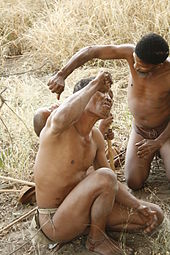
San drinking from a tuber
It turns out that water can come from many places other than a faucet or a pump. After they have run out of watering holes, wet sands and water stored in buried ostrich eggs, the San extract moisture from tubers growing beneath the ground. It is about as close as this desert comes to a water cooler but only a native could find its sublimely subtle shoots and live off the moisture they have to scrape from it. Anyone else would expire, which explains why Insiders – especially the pedigreed variety – has an advantage.


To Find Money and Business: “Salt the Monkey”
Since a real Entrepreneur may require the same ability to survive what is metaphorically a desert, how can they do it if they are an outsider or a visitor to this terrain? While the San have their proprietary ways of storing and finding these tubers, what would a newcomer – a disruptor - do? One famous example is how visiting non-San tribesmen from surrounding areas use other animals like baboons or monkeys in the desert to help them find these sources of water. They do this by trapping the monkeys and feeding them salt so they get thirsty enough to lead them to water.
How they do this is quite astounding. It requires finding a monkey hangout, an anthill, some seeds or any shiny object, twine and the aforementioned salt. First, the visitor drills a hole in the anthill at about crouching height. Anthills are built with a mixture of sand and mucus and have the virtual strength of cement, so making the fist-sized hole takes work. Next, the visitor appears near the monkey and plays with his seeds, making sure to get its attention. With great showmanship that ensures the monkey observes, he places his hand in the amply sized hole and drops the seeds. Then he walks away. The monkey, being a highly curious creature, will head for the anthill once the tribesman has left the scene put his hand in and grab the seeds. However, in making the fist, the monkey finds the hole is not big enough to remove his hand bulging with the seeds. Since the curiosity of monkey so consuming, he cannot let go of the seeds - and so he is trapped.

If all of this sounds eerily like the way you attracted your first customer, sponsor, corporate champion or Investor, so be it. But there’s more - the monkey is yet to do its real work. The patient visitor then walks up to the self-trapped monkey, attaches the twine to its neck and shakes the seeds loose from his hand, thereby freeing the monkey. He then ties the monkey to a tree and hands him the salt. The monkey devours the salt and quickly develops a hellacious thirst. At that point, the visitor undoes the leash and follows the parched monkey to his stored water source, which is typically an underground pond or lake.

That is how you survive the desert and “develop” a champion. With a little imagination, you can see that launching a Startup may not be all that different: you may have to find alternate sources of funding that can sustain you and ways to salt the monkey – that is, getting other people to lead you to the resources needed for sustenance. This is the kind of resourcefulness that tells Investors you belong in the business. It separates the Entrepreneur who will simply feast on the Investor’s money hoping for good fortune and the ones who will use that money to get up and go build a business!  http://bit.ly/1DNYIO4


Monday, December 23, 2013

Winners at the December Startupalooza


We really appreciate everyone who came out in that challenging weather.

The winner was iSpeech with its exciting new talking "Stickers" product
The runners up were:

Nonnatech, an intelligent remote monitoring environment for eldercare.

Evospend, a "white label" debit card service for small retailers.

Cream, a fashion retailing marketplace that monetizes fashion bloggers.

As we saw, the entrepreneur community is alive with ideas - as we expand, we are opening this up to new kinds of deals and out of town Start-ups.

Please feel free to share your thoughts.

We wish you Happy Holidays and a wonderful New Year!


Judge taking a pitch


Winners iSpeech talking to judge


"Voice" singer Cameron Novack performs for judges

Wednesday, December 4, 2013

Winners from the November Startupalooza

November was one of the biggest Startupalooza's of the year with over 40 presenting companies.

Streamed-In Presenters


Winner: SaveOn
Congratulations to the winner, SaveOn - the Kayak-like supermarket price and sales aggregator

They will be participating at the Private Equity Forum on January at the Yale Club - a $1500 value.


The first runners up were:
Patients Create The patient-centric crowdsourcing platform for healthcare development.
Dashbid - The software and service to help publishers increase video ad revenue yields.

Streamed-In Presenters


The Second Runners Up were:

Ledger - the prepaid corporate card company.

HandsFree -  Quikiks Hands-Free Shoes allow people with physical or cognitive challenges to step easily into and
fasten their shoes without hands.

Simbiot - Cloud-enabled platform for research and collaboration for science researchers to handle Next Generation
Sequencing and other genomic data.

KidKlass - "Open Table" for scheduling children's classes. 

Ca7h - Wearable connected camera that combines beauty, the power of smartphones and the internet. 

BeautyStat - The cosmetics deal site.

Rankings
We will be releasing the composite Judges' rankings so entrepreneurs can see how the investor community ranks 


your startup.
While we run this as a contest, we understand this is often about comparing apples to oranges - nevertheless, it is 
an invaluable guide. 

For that reason there are many winners - each with their own funding possibilities.
Back In December 9 (Virtual)  & 16 (Live!)
We will be back on December 17th with a Year-end Startupalooza.
We will be doing a Virtual Startupalooza pitch event n Dec. 9 that you can sign up for here.

Anyone signing up for the virtual event goes to the live event free!

REGISTER


Alan Brody and the Startupalooza Team


Saturday, May 19, 2012

TEDx EAST Report: The Good, the Bad and the Missing


To those of you who wondered, we apologize for any misunderstanding. What took place is an interesting tale of kool-aid and competition.
  

The organizers, who have done a great job building TEDx East over the past few years arranged to do this event at Alice Tulley Hall at Lincoln Center - the pinnacle of NY venues. 

Given the proliferation of TEDx's like TEDx Gotham, TEDx Manhattan, and TEDx Wall Street this might have been a kind of non-profit's end run.

Nevertheless, with 1100 seats to fill, this was a tall and very expensive order. So, we were approached to help promote it return for the usual - guest seats and promotional consideration.
   
They also wanted help selling sponsorships, which seemed very attractive except for the $25,000 price tag - in this economy! More significantly, not all sponsors will take the kool-aid - explaining the audience demographics or content can be a challenge. It is not a parade of Nobel laureates, it doesn’t reflect NY’s entrepreneurial culture and it offers no stars with current marquee value. It is just TEDx East and to many sponsors that can look like a dilettante’s ball.
  
Nevertheless, we gamely promoted it to our community and to our amazement, after sending out over 20,000 emails and Social Media messages, we began getting notices that it was sold out.
  
Good for them!
  
We probably should have called to high-five, but our work seemed done and whatever advice we'd had about price points and demographics seemed irrelevant. Unbeknownst to us, TEDx East hadn’t achieved anything like their numbers and so they had quietly switched venues without telling anyone except the people whose registrations they had accepted (you don’t just buy a ticket, they have to approve you!). There wasn’t even a notice on their website about the new venue, the more modest, NY Times auditorium.
  
The net result is late registrants (including us) were sent to the original Alice Tulley Hall where no one had a clue. The only way they got oriented was by viewing the Twitter feed for the occasional mention of the NY Times venue.
  
Once these bedraggled latecomers appeared, they were met with a vastly reduced version of TEDx - and they had to wait for the good stuff to reappear. As for the sponsors, none of the originally announced ones were in evidence except for a “globo” sign from the History Channel and a selection of new energy bars. They were ironically useful since latecomers arrived for the dance and music performances which were hardly ideas worth sharing. I have nothing against the performing arts, in fact I have helped present several off-Broadway shows including one now at the Little Schubert Theater called “Potted Potter.” But the theme was “The View From in Here.” So, was that a visionary gathering or just a view from the ivory tower and inviting whoever is playing in the courtyard. As for the History Channel - don't they look backward?
  
Assuming they are trying to make the point that we are producing today’s history then, from the performing arts we learn the following: you can be a fantastic dancer at 80 if you don’t mind prattling about creation myths, opera singers can be skinny and still have great voices and classical music continues to have a vibrant new generation of practitioners. The kids from PS22 sing pretty well and their tiny soloists have definitely mastered the art of swagger.
  
As for the “ideas worth sharing” there were some wonderful presentations that genuinely reflected the TED zeitgeist: John Marks, “you are not an Ape” (whew!), Maya Lin’s topographical architectural visualizations, Helen Fisher’s Biology of Mind was a fascinating journey into the 4 key brain chemicals that define personality types. Antonio Bolfo, the policeman turned photographer, had an interesting perspective on the stories that pictures tell (context is everything) which was an ironic contrapuntal to Sam Gregory’s “Visual Anonymity in a Surveillance Age.” To keep away from the policeman’s eyeball, you need face paint or some other way to fool their facial recognition systems. Think capcha for faces.
  
Entrepreneurship was represented in the form of the 13 year old Cassandra Lin who’s story of turning old cooking oil into a home heating oil and helping around a 100 needy families in Rhode Island was inspiring. Entitled, “Be Your Own Superman” it was, understandably, the day’s sole hyperbole since it represents a extraordinary achievement brilliantly told by this teen. It was also strangely misleading because it encouraged you think she had invented a new way to turn cooking oil into energy. That would be superhero stuff, all right. In fact, she was a precociously grounded young businesswoman for the public good who knew how to tap the local recycling and political system. She steered old cooking oil to the local biodiesel refiner who was able to deliver some amount refined product to the poor for free and still make a profit. The lesson here is not go invent, young person or even think kind or be supercreative - it is get business and politicking savvy. A great lesson, but subtly different from the one advertised.
  
The event ended with a ponderous lesson from a Finnish educator who flew in to tell us what we can learn from Finland’s stellar school system. Maybe he knew that he had nothing but bad news for us or perhaps it was just cultural, but these are not answers we want to hear: don’t change so much, you could be wrong and unlike us, Finnish culture cherishes teachers. They may not do it for the money but everyone wants to marry a teacher. So, lesson one: don’t raise the budget just hand out free match.com subscriptions and somehow boost their profiles. Lesson 2: everyone learns differently so cut back on those standardized tests and teaching. Bottom line - the slow food movement will give way to the slow teaching movement - plus extra love.
  
We can’t end without noting David Pizarro’s “How Disgust Shapes our Thoughts on Moral Wrong and the Political Right.” Aside from beginning his talk with the disgusting image of putrid flesh, his message was that people will almost never agree with you if you start out by disgusting them - unless you want them to be just as disgusted by the political opposition as you are. The obverse of this - which retailers long ago figured out - is that you can just as easily charm customers into agreeing with you (i.e. buying stuff) with great smell. Hence the olfactory stimulation at the mall.
  
If only entrepreneurs knew how create the smell of money, investors would be more willing to write checks! 

Maybe Supergirl will figure this one out.

Thursday, December 8, 2011

A Teachable Moment? Report from the Dec. iEvening


Report from the Pitch iEvening for Entrepreneurs 

Need to raise a million? The iBreakfast/iEvening series has helped Start-Ups raise over $40 million. This powerful iBreakfast/iEvening quarterly meeting of entrepreneurs, VCs and seasoned execs enables start-ups to find their "Power Pitch™" while offering a unique opportunity to raise capital.

 . 
VC Panel lead by:    John Ason, Angel Investor   •   Heather Gilchrist, RAK Tech Fund   •   Allan Grafman, All Media Ventures    •    David Teten,  ff Venture Capital      •      Moderated by Alan Brody    

Nikhil Paul, CEO Nfoshare & Alan Brody, Moderator, iEvening


The Report: A Teachable Moment

Every Entrepreneur iEvening seems to have its own theme. We don’t plan for it but it somehow works out that way. Last time it was medical plans.

This time it was education.

Not only was our winner, Andrew Cohen’s Brainscape, an educational product (popular multimedia flash card apps) but so were the runners up.

Even your humble host of the workshop was invited to put the collected wisdom of the Entrepreneur Power Pitch panels into an educational format. (More about this blog and eBook later).

Our panel of investors included Heather Gilchrist of RAK Tech Fund who had succeed with an educational product. John Ason, the Angel Investor who gets to write his own checks has some educational investment but Allan Grafman of All Media Ventures and David Teten of ff Venture Capital are not generally there. But they voted for it anyway.


Maybe it is just the current mood. No one seems to understand the economy, what to spend our money on or even what to manufacture - so why not get an education? And hasn’t the cost of education outpaced the economy. So there it is - an overpriced enterprise ready to be taken apart by technology: reducing analog dollars into digital pennies by turning pedantry into personal pedagogy.

BrainScape came out of Columbia and seems to include a little of a very hot commodity according to number of our judges, “gamification”. It is not just learning with your own flash cards, or borrowing from others who have been there before but you can have some fun doing so too.

The runner up was Rami Cohen, MD whose Tel-Aviv start-up, Telesofia comes with a special pedigree, he worked with ICQ founder and Israel Start-Up guru, Yossi Vardi. Telesofia, is a platform for creating personalized video communications between doctors and patients. A form of education, you might say.

Another runner-up was Nfoshare, a website that allows college students to tap the collective wisdom of their class by tying the professors, tutors and students into an ongoing forum. It spares the professors from endless of questions and lets the slow kids tap the knowledge of the smart kids.

Afiniate's IntentEngine™ software, produced by Ram Singh, the winner of our DC event, educates banks on the needs of their customers and feeds them offers they are likely to be interested in.

Firmcontour educates you on how to lose weight. After getting your personal profile it delivers a customized menu for your weight loss or dietary needs for just $12.95 a month.

ZeroIn Media educates banks customers on whatever the banks deems worthwhile -on flat screen TVs as they wait in line.

Finally, Candid Capture, educates employers about the candidates they are looking to hire by allowing them to capture structured video interviews for perusal on their own time.

PowerPitch workshop - once again we used the power of our panelists to help the Entrepreneurs shape their plans and calibrate their messages for various kinds of investors. It also raised so many issues that Entrepreneur asked us to begin the eBook below.

A special thanks to our sponsors Herrick Feinstein for hosting a marvelous event with great refreshment and food & wine breaks.
      ____________________________________________________

Due to popular demand and as part of the iEvening Education theme, we will be releasing a compilation of our PowerPitch Workshop’s book of wisdom.

POWER PITCH™ - TAPPING THE HIDDEN RULES OF START-UPS

The heart of this workshop is focusing on the pitch - that 10 or 15 second elevator shpiel. It sounds simple and doing some kind of pitch is simple. But doing the right pitch is incredibly because it makes you focus on the essential, communicable element of your plan.

We stumbled upon this through two sources. One of our investors told us that the lives for 3 phone calls he gets every morning that rave about this new start-up or Entrepreneur. Then Bloomberg TV approached us to do a show about our startups and they asked, so what do these companies do?”

It turned out to be almost impossible to explain and so we recognized the challenge:

How do we get entrepreneurs to reduce their idea, management, specific experience, technology and marketing plan into a bite-sized chunk? How to make it relevant to a potential investor? How to turn it all into a meme so that angel investors can pass it around to their colleagues like a chit in the favor bank?

How do you get your idea to become remarkable to investors? How do you make it go viral for the checkwriters?

We came up with the idea of using their colleagues. We found out that the best way to do it is to make a group of your peers give you the feedback you need. After all, they are most like you: the VCs can be dumb, your loved one may never understand you but if your peers don’t get you then you know you have work to do.

That’s the essence of the PowerPitch Workshop. But in order to manage it you have to know a lot about the mindset of Angel VCs: what they are looking for, how they handicap you and how they get into their own kinds of buying frenzies. That is the essence of this book, gleaned from years of listening to the VCs after you’ve left the room.

They have their own ideas, their own rules of thumb which they generally don’t share with you. Much of the time they don’t really articulate it because it’s a given.

But not to you.

You also need to understand whether you are investible - how to improve your chances or how to find more accessible and far cheaper sources of capital.

Many of these points are on the blog and this outline will direct you to some of the points already written and all the rest waiting to come.

Are You Fundable? An outline of our coming eBook
  1. Are you investible? Understand what investors are looking for before you pitch. In our blog.
  2. How do Investors rank you? Eskimos have 57 words to describe snow and the Bedouin have 100 for a camel. What do Investors have for entrepreneurs?
  3. The Secret to Pitching: the “3rd Dimension”  In our blog.
  4.  5 Things you should NEVER say to a VC - 5 things you SHOULD.
  5. The Jockey vs. the Horse - the key to your future.  In our blog.
  6. How to dream the meme - like DNA and Google you can make yourself stumble on the key idea.
  7. How to spot a VC.
  8. How to calibrate your message for different VCs.
  9. VC Frenzy: What you can learn from Tupperware.
  10. How to launch a business when you’re “the 99.”
  11. How to survive the drought.
  12. Plan B: Do you Pivot or Deconstruct?
  13. Payday? All about Termsheets.
  14. How to grow: Lessons from billion dollar companies I helped.

Tuesday, November 30, 2010

iEvening Entrepreneurs Report

Brian Cohen, NY Angels · William Reinisch, Paladin Capital · Mike Segal, Joshua Capital · Joseph Daniels, Hodgson Russ
Moderated by Alan Brody

The long-running iEvening is one of the Tri-State's most valuable working events for Entrepreneurs and now, Execs - it helps Entrepreneurs shape their business models while looking for funding and Executives reinvent themselves while seeking opportunities.

Alan Brody at Workshop
Last Tuesday's event was hosted by the Fordham Business School at Lincoln Center. The Entrepreneur's Workshop, which has been running for over 10 years was recently expanded to accommodates executives - although the workshop has always attracted Execs seeking renewed career opportunities through Start-Ups, they were never formally part of the program. Now they are.

The Workshop
In the technique we pioneered for a Bloomberg TV segment, members of the group are invited to give their 30 second pitch. By using the dynamics of the group, we quickly discover what those pitches really do and don't say about the company or executive which leads to some great discoveries. Entrepreneurs learn what gives their ideas "curbside appeal" and execs learn how to pivot their business experience in the same way a Start-Ups has to keep looking for the right way to connect to its market and its investors.

One Start-Up founder, which struggled to explain himself succinctly happened to mention a much catchier second company called Wazzup - the group response made it clear where the opportunity really lies. Another Exec, who had been helping Start-Ups shape their pitch was shown by the group how the same techniques could also apply in everyday sales situations, opening the door to a new kind of consulting practice. Other Start-Ups found that while analogies are a great way to describe a new company, they have to be the right analogy or they could also be misleading. An Exec from a Start-Up that went public discovered that even though he did not cash out like the principals, just by being part of an IPO he can claim membership in the sacred group of the Serial Entrepreneur who IPO'd - thereby boosting his value. (More about the secret hierarchy or Start-Ups in my upcoming book....!)
Joe Daniels, Hodgson Russ & Paul Wegener

Deal Structure Workshop
After the Workshop, Joe Daniels of Hodgson Russ gave an illuminating presentation of deal structure and the clear value in seeking good counsel while going through the various stages of creating the Start-Up. The ability to raise capital, retain ownership value and share stock with employees are highly dependent on the quality of advice at this early stage.

Entrepreneur Pitches
The pitches included some very promising companies. The winner, who will go on to attend the Private Equity Forum at the Yale club was Caleb Gandara of TuitionCast - a metasearch site for higher educational programs.
The panel of judges which included Brian Cohen of New York Angels, Bill Reinisch of Paladin Capital and Mike Segal of Joshua Capital listened to the following plans and advised the companies to sharpen their focus in a variety of ways.

Mike Segal, Brian Cohen & Bill Reinisch
MergeSkills (www.mergeskills.com) was advised to focus their value proposition relative to competitors like LinkedIn, eLance and Guru.

Conexus (www.nq.com) which adds marketing intelligence needs to evolve their offerings to advertisers.
Traversive, (www.traversive.com) which enables IT departments in small to medium size businesses to shop for providers, the judges thought they needed to focus on a more specific market niche.

Risk-AI (www.risk-ai.com) provided risk analysis tools for the hedge fund industry but appeared too small of a niche for investors looking for a minimum 10x growth.

The Panel in Action
Remote Stylist (www.remotestylist.com) suffered from a similar judgment - although the market is big and they loved the founder, Kelly Fallis, the site appeared too manually service-oriented to scale - what investors call a "lifestyle business."

LEO (www.kryonsystems.com) a surprise entrant by an Israeli company that turns point and click tutoring into a saveable feature to be shared by other users. Investors leery about the training business but intrigued by the functionality.

So what is an Entrepreneur to do: fix it, pivot their model or constructively deconstruct? How about growing it themselves organically through sales an partnerships? These are the issues every entrepreneur faces and we hope the iEvening and its collaborative environment helps them make them make the right decision.

About the Speakers 
Entrepreneurs - photos by Seitu Oronde
Brian Cohen is Vice Chairman of New York Angels is an investment group of 61 members.
Joseph Daniels is the chair of the Hodgson Russ' Emerging Companies & Venture Capital Practice Group.
Bill Reinisch runs Paladin Capital's New York office.
Mike Segal heads Joshua Capital
Alan Brody pioneered the Business Model Discovery Workshop for Bloomberg TV

Find us on Facebook                   View our profile on LinkedIn                  Follow us on Twitter                Submit Business Plan
