Section 1 - Summary
The Entrepreneur’s Guide to Winning Over Investors
by
Alan Brody
After 12+ years
of evaluating pitches and helping entrepreneurs raise money, we have put
together a book of rules on what it takes to get funding. What Investors look
for and how to make your plan fundable. By looking through the prism of Angel
Investor wisdom. It tells you how to:
• evaluate an idea
• find the right investor
• build sales
• attract sponsors
• pivot, reconstruct or know when to fold
At the heart of
the book is this idea: you understand Start-Ups by seeing them through the eyes
of investors. If you know how they handicap you, then
you not only know how to get ahead but which race you should be in.
Not all Start-Ups
are the same. You already knew that, but do you know what sets them apart in
the minds of investors? When you do, you can increase your chances of success
dramatically.
Why Ask “Am I Fundable?”
The key reason
to ask is that it forces you to think about your enterprise from the outside
in. When you do that, you get out of your own spin zone and into the mindset of
real customers and investors.
Here is what you
will discover:
1.
There
is a hierarchy of Start-Ups - you
need to understand where you belong on that line-up.
2.
Customers and Investors
may be connected to each other but
often have very different points of view – what makes a customer want to buy
your product or service can be different from why an investor would want to
write you a check.
3. All businesses have to adjust their much loved ideas to the reality of the marketplace.
4. When you know what you have and how it is
really perceived, you can calibrate
your message for each audience: investors, customers and potential partners.
You can also realistically determine how to spend your – pursuing customers or
investors in just the right measure, instead of wasting time doing both
incorrectly.
THE MAP OF ENTREPRENEUR LAND….MINES
The Start-Up Hierarchy: What Kind of
Entrepreneur Are You?
The heart of Are You Fundable? is the idea of a
hierarchy of Start-Ups and then a matching taxonomy of investors. Investors
handicap you according to your status. If you pitch an idea that is
inconsistent with your status you will probably lose credibility. Without
credibility, you don’t get funded or even attract business.
The Hierarchy of Entrepreneurs
 What is a Serial Entrepreneur?
A serial
entrepreneur is someone who has started one or more businesses. These Kings of
the Start-Up realm can sit by the phone and investors will offer them money
just in case they come up with an idea.
What is a Semi-Serial Entrepreneur?
At the next rung
are serial entrepreneurs with a mixed record.
The Pedigreed Start-up
At the next
level down in the hierarchy are what we like to call the Pedigreed Start-ups. I can say anecdotally, that these people seem
to get the lion’s share of the Start-Up money. Almost anyone with 10 years in
an industry could make a case if only they found the marketable idea within
their domain of expertise and understood the “rules.”
Pedigreed
Start-ups are people who have:
• 5 or more
years of domain experience in a field (10 years seems to be the sweet spot)
• have
identified a key market with a critically needed product in their field
• have the
developer team in place with the product ready or at least a working demo
• have the
customers who want or need to buy it
Not-So Pedigreed
Here are some of
the traps this kind of entrepreneur can fall into. Investors look out for this
and if you are not careful, you can disqualify yourself:
• Salaryman/woman: never been an entrepreneur before
• No skin in the game – as in not having
your own money at risk, is negatively viewed.
• Tied to a paycheck: the risk with this
type of entrepreneur is that they could be more interested in finding a
paycheck than in taking on the struggle of launching a business. • Mixed age team. Having an older manager
and a very young developer raises generational issues.
• Acting like an exec. Don’t be aloof, you’re supposed to
hustle or it will seem like you never left the previous company.
• You were fired. Tricky and best left to
the later conversation but if you were fired for being an entrepreneur, as long
as you were one in the past is not a bad story.
• The worst sin: coming up with an idea
that has nothing to do with your
previous line of business.
Moonshots, Up-and-Comers and
Career-Enders
At the bottom
level are the youngest and the oldest. These are the folks who come to our
really early stage Start-Up events called Startupalooza.
They are the heart and soul of the TV show “Shark Tank” and they are the
biggest winners when they get it but overall, the most consistent
group of losers. They either reach the moon or fizzle out trying.
1. The greatest
Start-Ups are usually founded by people under 27 Google, Microsoft, Facebook,
Apple, Netscape and so on.
2. Only the
young can invent the defining ideas of their generation which is by definition,
an untapped market.
2. They can
afford to take the greatest risks since they have the least to lose. The right
person is also adaptable, able to struggle, accept loss and still recover.
3. They appeal
to the vicarious reinvention psychology of Angel Investors.
4. Young people
who have these qualities – even if the idea is wrong or the investor doesn’t
invest in their deal – are a kind of currency that Angels like to “trade” with
each other.
5. They have
nowhere to go but up.
Let’s Give them Something to Tweet About
The way
investors find out about great Start-Ups is that people talk.
The Up-and-Comer
Most Start-Ups
have a good idea that is essentially a twist on other ideas in play.
The Older Player
If you are over
50, you can pretty much forget about getting Angel money. Angel Investors will
probably deny this but I am sure they will also want you to believe they are not a day over 50 either.
The Going Enterprise that Seeks Growth
For a company
already showing profits, to bring on investors is usually a double edge sword.
Their actual profits tend to put a cap on their valuations.
Scalability
This is more
challenging than it seems. Do you have a formula that with nothing more than
the addition of capital, will generate more sales?
Transformative Element Not just
projections,
-->
something that the changes
the business paradigm.
What
Impresses Investors
How
to Improve the Way Investors Rank You
Get a Lead Investor or Champion or Make Friends with Serial Entrepreneurs
If you don’t
have a lead investor or at least an investor who introduces you to other
investors, or a serial entrepreneur, the next best thing is a fellow
entrepreneur.
Thumb on the Scale and other Anti-competitive
Ideas
They want to
know if you have a thumb on the scale –
a special advantage that others don’t have and can’t see.
Patents
A defensible
patent is prized by investors, but any patent along with business momentum
carries value because it has the possible effect of warding off competition.
Barrier to Entry
If you don’t
have a patent then you want to convince investors that you have some type of barrier
like special equipment or rarefied knowledge that competitors either can’t get.
First Mover Advantage
This is
essentially what Amazon had as the first online bookseller. The reality is not
so much that the first in a market as much as the first credible player in the market wins.
What Investors Don’t Want
Lifestyle Business – the Big No No
 What they cannot
abide, what the live in fear of is the lifestyle business. Be careful of phrases that suggest this: like having a steady business, being a consultant or living off sales.
What they cannot
abide, what the live in fear of is the lifestyle business. Be careful of phrases that suggest this: like having a steady business, being a consultant or living off sales.
What Investors Fear
Settling (A Tribute of Sorts, to
Steve Jobs)
Even the idea of
selling out too soon – or settling will upset an investor.
The Zombie Business
Never quite
taking off but never quite dying either. You always need more money because
you’re always just about to break .
Failed Execution/Failed Idea
Fix it and then
pitch….
The Tells – How you Know You Need Help!
a.
“If we just had 5% of Google’s (or
Apple/Facebook/put_big company_name here) market we would be worth a billion Sure!
b.
We
need the money for sales and marketing. When you ask for money in order to sell you’ve just told them you don't have the confidence to sell yourself.
c.
We
have no competition
Hosni
Mubarak used to say the same thing about his Egyptian regime and for 40 years
he was right. Then along came Facebook. There is always competition.
d.
Our
competition is Microsoft, eBay and Google - but they don’t get it.
Nor
do the investors.
What
kinds of deals investors are looking for?
What Investors DO Want
The rule of thumb for fast-rising business in a massive, emerging
market is a
defensible business in a sector that is likely to double every year for 5 years
in at least a billion dollar market. They also need to know that it is scalable
through capital.
|
Part 2 discusses fundable ideas like anticipation, natural progression, aggregation, undercutting. How ideas are measured and rated. How to pitch them, how to value and how to move to the next level. |
 The more you can successfully bootstrap the company, and
progress through your own financing or machinations, the more you impress
Investors with your ability to deliver. So consider this a test you must pass –
whether you get funding or not. If you want to know how to endure “the drought”
and go on to find money, think of the Bushmen.
Now generally referred to as the San,
they live in the Kalahari Desert where there are no camels and few oases with
springs or even wells where they can pump water out of the ground. They get
rain during one season of year, and conserve what they can with little
technology beyond filling ostrich egg with water and burying them in the sand.
The more you can successfully bootstrap the company, and
progress through your own financing or machinations, the more you impress
Investors with your ability to deliver. So consider this a test you must pass –
whether you get funding or not. If you want to know how to endure “the drought”
and go on to find money, think of the Bushmen.
Now generally referred to as the San,
they live in the Kalahari Desert where there are no camels and few oases with
springs or even wells where they can pump water out of the ground. They get
rain during one season of year, and conserve what they can with little
technology beyond filling ostrich egg with water and burying them in the sand.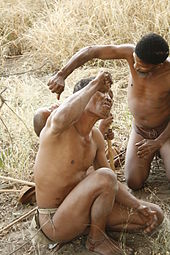
 How
they do this is quite astounding. It requires finding a monkey hangout, an
anthill, some seeds or any shiny object, twine and the aforementioned salt.
First, the visitor drills a hole in
the anthill at about crouching height. Anthills are built with a mixture of
sand and mucus and have the virtual strength of cement, so making the
fist-sized hole takes work. Next, the visitor appears near the monkey and plays with his seeds, making sure to
get its attention. With great showmanship that ensures the monkey observes, he
places his hand in the amply sized hole and drops the seeds. Then he walks
away. The monkey, being a highly curious creature, will head for the anthill
once the tribesman has left the scene put his hand in and grab the seeds. However,
in making the fist, the monkey finds the hole is not big enough to remove his hand
bulging with the seeds. Since the curiosity of monkey so consuming, he cannot
let go of the seeds - and so he is trapped.
How
they do this is quite astounding. It requires finding a monkey hangout, an
anthill, some seeds or any shiny object, twine and the aforementioned salt.
First, the visitor drills a hole in
the anthill at about crouching height. Anthills are built with a mixture of
sand and mucus and have the virtual strength of cement, so making the
fist-sized hole takes work. Next, the visitor appears near the monkey and plays with his seeds, making sure to
get its attention. With great showmanship that ensures the monkey observes, he
places his hand in the amply sized hole and drops the seeds. Then he walks
away. The monkey, being a highly curious creature, will head for the anthill
once the tribesman has left the scene put his hand in and grab the seeds. However,
in making the fist, the monkey finds the hole is not big enough to remove his hand
bulging with the seeds. Since the curiosity of monkey so consuming, he cannot
let go of the seeds - and so he is trapped.


